
What can you realistically create in one Content Day?

A Content Day can produce far more than one promotional video or a new set of headshots.
With the right planning, one day can create photography and video for your website, social media, recruitment, campaigns and future marketing.
But there is an important word in the title of this article: realistically.
A Content Day should not be treated as an attempt to capture absolutely everything a business could ever need. Trying to squeeze too much into the schedule usually leads to rushed photography, tired contributors and weaker video.
The aim is to identify the most useful outputs, prepare properly and make the day work as hard as possible.
A realistic example
For a business with one main location, a prepared team and a two-person production crew, a balanced Content Day could realistically produce:
Headshots for approximately 10 members of staff
40–70 edited brand and workplace photographs
Interior and exterior photography
6–10 short FAQ or expert videos
One or two longer interview-led videos
Supporting B-roll captured throughout the day
Short clips suitable for social media
Behind-the-scenes content
Hero photography for website pages or campaigns
You are looking at a substantial amount of content.
It is also not a guarantee or a rigid package. The final output depends on what the business needs, how many people are involved and how complicated each setup is.
The important thing is to agree the priorities before the shoot.
Where to start? Start by deciding what matters most
Not every Content Day should contain the same mixture of photography and video as some businesses need a large new photography library with a small amount of supporting video.
Others need a series of interviews and FAQ videos, with photography captured around the main filming schedule.
Before creating the itinerary, I would normally help the client decide which of the following is the priority:
Website refresh
Recruitment
New service launch
Social media content
Customer testimonials
Team photography
Brand awareness
Training or educational content
A campaign or advertising requirement
That priority determines how the day should be structured and where time (and importance) is allocated.
By giving everything equal importance is often where problems begin.
A photography-led Content Day
A photography-led day might include:
Individual headshots
Group photographs
Staff working and interacting
Meetings and consultations
Workplace and environmental photography
Interior and exterior images
Product or service photography
Hero images for important website pages
A custom library of more general brand imagery
A small amount of social B-roll
This approach works well for a new website, brand refresh, annual report or recruitment campaign.
Depending on the number of people and locations, the client might receive between 60 and 100 finished photographs.
Video can still be included, but it would usually be limited to a few short interviews or supporting clips rather than several heavily produced films.
A video-led Content Day
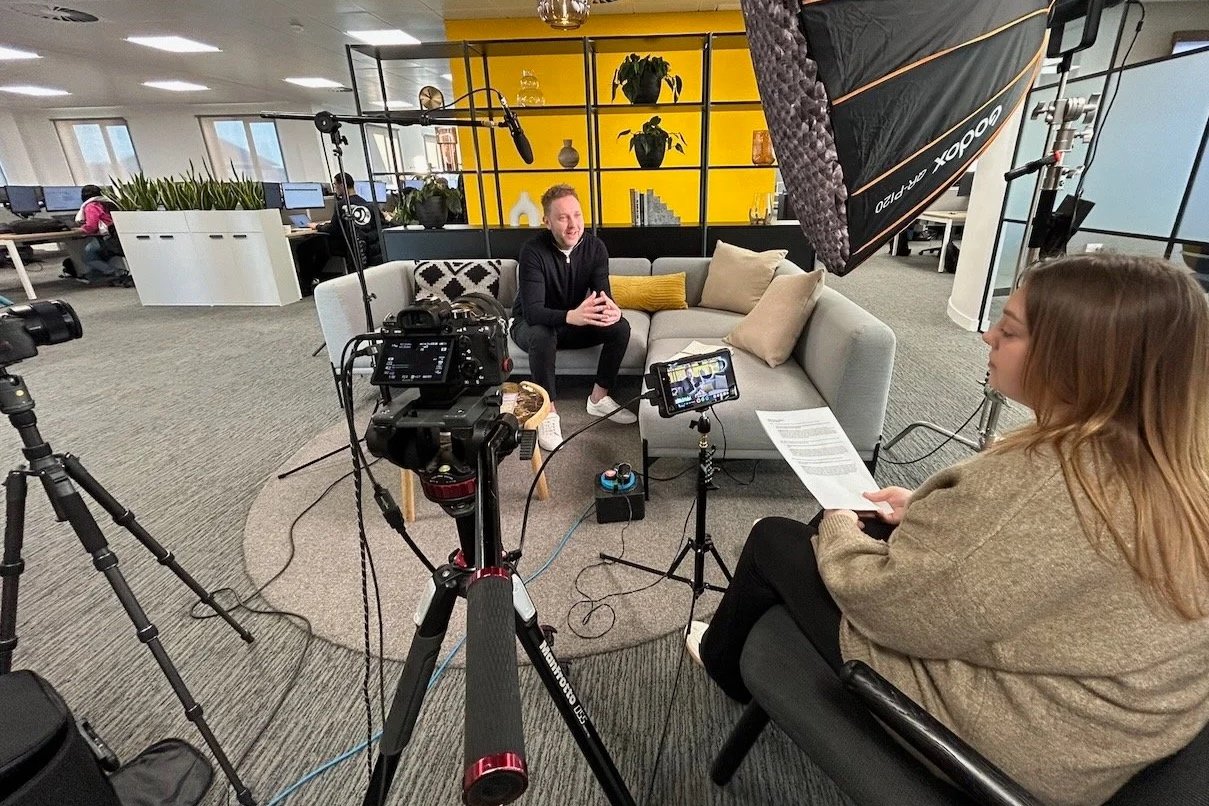
A video-led day places more time into interviews, sound, lighting and repeated takes.
It might include:
A main interview or promotional film
Two or three customer or staff interviews
8–12 FAQ videos
Short direct-to-camera social videos
B-roll of the team, workplace and service
Several short social edits
A limited set of supporting photographs
Video normally takes longer than photography. A photograph can be captured in a fraction of a second whereas a one-minute finished video might require a longer interview, several takes, multiple camera angles, clean audio and supporting footage.
That is why a day containing 10 FAQ videos and two longer interviews may only leave enough time for a focused set of photographs rather than a complete brand library.
What might the day look like? An example itinerary
Every project is different, but a balanced itinerary could look a little something like this:
8.00am - Setup
Lighting, sound and camera setups are prepared before the main team arrives.
The headshot area can remain in place for much of the day so late arrivals can still be photographed.
9.00am - Headshots
Photograph approximately 10 members of staff while people are fresh and before the working day becomes too busy.
10.30am - Workplace and brand photography
Capture people working, team interactions, meetings, details of the environment and the wider business.
This should include both planned scenes and genuine activity.
12.30pm - Interiors and exteriors
Photograph the building, important rooms, signage and wider location.
Exterior photography may move to a different point in the day depending on weather and light.
1.00pm - Break
1.30pm - FAQ and expert videos
Film short answers from key members of staff.
These might cover common customer questions, explain a service or provide useful insight around a specialist subject.
3.00pm - Longer interviews and testimonials
Capture the more considered interview content, customer stories or main promotional material.
4.15pm - B-roll and additional ideas
Film supporting footage, social clips and any useful ideas that have emerged during the day.
5.00pm - Close
This is only an example.
A hospitality shoot, factory, university, law firm or recruitment business would each require a different approach.
A balanced photography and video day
This is the approach many clients are most interested in.
A balanced day might include:
Headshots for up to 10 people
Brand and workplace photography
Interior and exterior images
6–10 FAQ videos
One or two longer interviews
B-roll and social footage
This can work extremely well, but only when the day is properly planned.
The photography and video setups need to be organised efficiently, contributors must be available at the right times and the location needs to be ready before filming begins.
A second crew member is also extremely useful.
While one person manages an interview or headshot setup, the other can help with lighting, sound, equipment, data management or supporting footage. This reduces the amount of time lost switching between photography and video.
What are FAQ videos?
FAQ videos are one of the most useful outputs from a Content Day.
They are normally short, focused videos in which a member of the team answers one clear question.
For example:
How does the process work?
What happens during the first appointment?
How long will the project take?
What qualifications do I need to apply?
What makes this service different?
What should customers prepare in advance?
They can be used on website pages, social media, LinkedIn, recruitment pages, email campaigns and sales follow-ups.
A standard FAQ video might be between 30 and 90 seconds long.
It would normally include one speaker, one main setup, captions and simple branded graphics.
It is important to distinguish this from a more heavily produced promotional film containing multiple interviews, locations and detailed B-roll.
What is a B-roll library?
B-roll is the supporting footage used around interviews, voiceovers and other video content.
It might show:
The team at work
Customers being helped
Products being made
Meetings taking place
Details of the workplace
Equipment being used
The exterior and surrounding location
General moments that help explain the business
A good B-roll library can remain useful long after the original shoot.
It can be used to create future social videos, update an existing film, support a new voiceover or add visual interest to an interview.
This is one reason I prefer to think beyond one finished video.
The supporting footage may become just as useful as the original edit.
What probably will not fit into one day?
A single Content Day is unlikely to comfortably include all of the following:
Headshots for 30 or 40 people
A complete photography library
Multiple locations
10 FAQ videos
Three detailed interview films
Several customer testimonials
Product photography
Drone filming
Complex scripted scenes
A large number of social edits
Some of those elements could be combined, but not all of them at a high standard.
Where the brief becomes more ambitious, we’d look to propose:
A second production day
A dedicated photography day followed by video
A separate customer testimonial shoot
Additional editing after the main project
A series of quarterly Content Days
The right answer is not always to work faster.
Sometimes it is to create a more realistic production plan.
Preparation determines how much we can achieve
Preparation is without doubt the biggest factor that determines the success and potential of a shoot.
A well-prepared client has:
Told staff what is happening
Confirmed who will be photographed or filmed
Prepared the workplace
Cleared unwanted clutter
Organised products, food or equipment
Thought about interview topics
Agreed the priorities
Made sure decision-makers are available
Allowed enough time for each section
When those things have not been done, valuable production time is spent moving furniture, finding contributors or deciding what people should say.
Preparation does not mean scripting every word or making everything feel artificial but it does means giving people enough information and thinking time to feel confident.
The best responses can still be natural - but they are simply less likely to require 15 takes. It’s also worth checking out our photo-guide for commercial and corporate photoshoots.
The finished content takes longer than the shoot
The Content Day is only the capture stage.
Afterwards, the photography needs to be selected, processed and retouched.
Interviews need to be reviewed and shaped.
FAQ videos require editing, captions, colour correction, sound treatment and exporting.
B-roll needs to be organised and prepared.
Feedback must be gathered and revisions completed.
A day containing photography and several video outputs can easily create a week or more of post-production.
This is why the number of finished deliverables needs to be agreed before filming.
Ten short FAQ videos are not simply ten files copied from a memory card.
They are ten individual edited pieces of content.
The real value is not the number of files
A successful Content Day is not about creating the largest possible folder.
It is about leaving with the right mixture of content.
That might mean:
Strong headshots that improve the team pages
Real photography that replaces generic stock imagery
FAQ videos that answer common customer questions
Interviews that build trust
Social clips that attract attention
B-roll that can be reused for future content
Hero images that improve important landing pages
Everything should have a purpose.
The strongest Content Days are planned around what the business needs to communicate, not around how many photographs or videos can be squeezed into eight hours.
Before planning your Content Day
Start by asking:
Who is the content for?
Where will it be used?
What are the most important outputs?
Who needs to be available?
What can be reused afterwards?
What should the audience understand, feel or do next?
Once those questions are answered, it becomes much easier to build a realistic schedule.
One Content Day can create an enormous amount of useful photography and video.
But the real advantage is not simply efficiency. It is that everything has been planned together, looks consistent and supports the same wider business goals.
Planning a Content Day?
If you need photography and video for your website, recruitment, social media or a wider campaign, I can help you work out what is realistic, what should take priority and how to get the most value from the day.